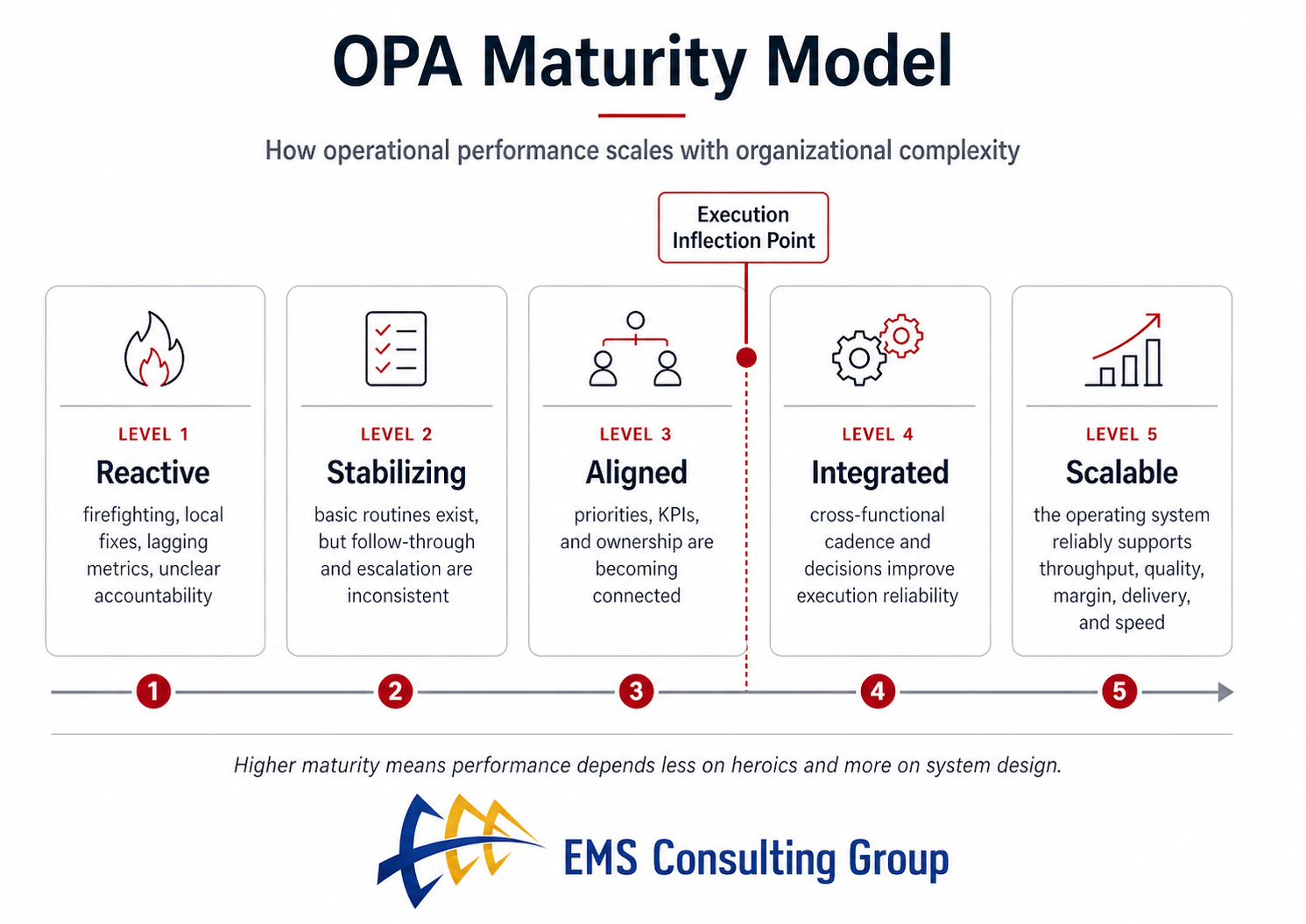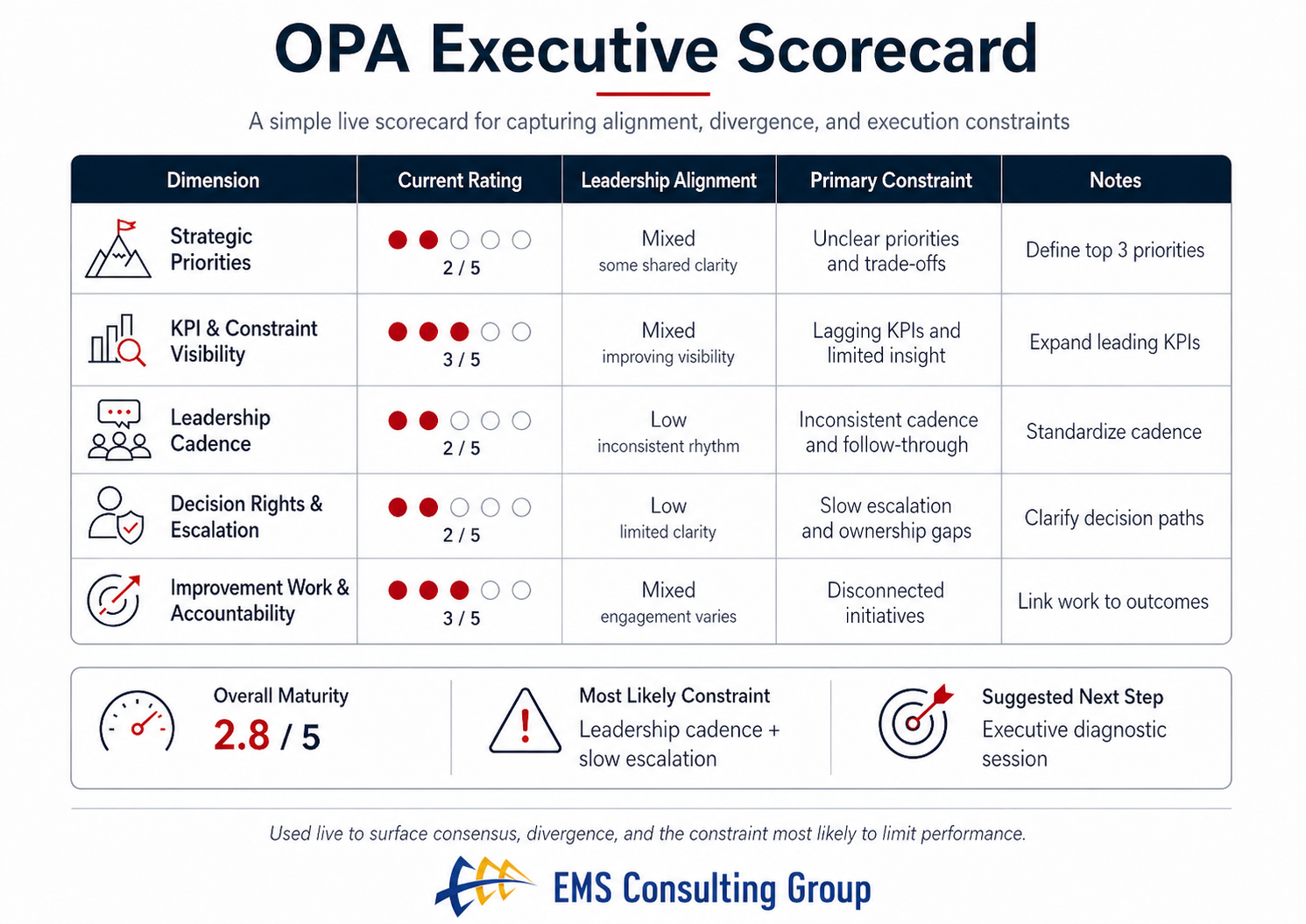
Operational Performance Architecture (OPA)
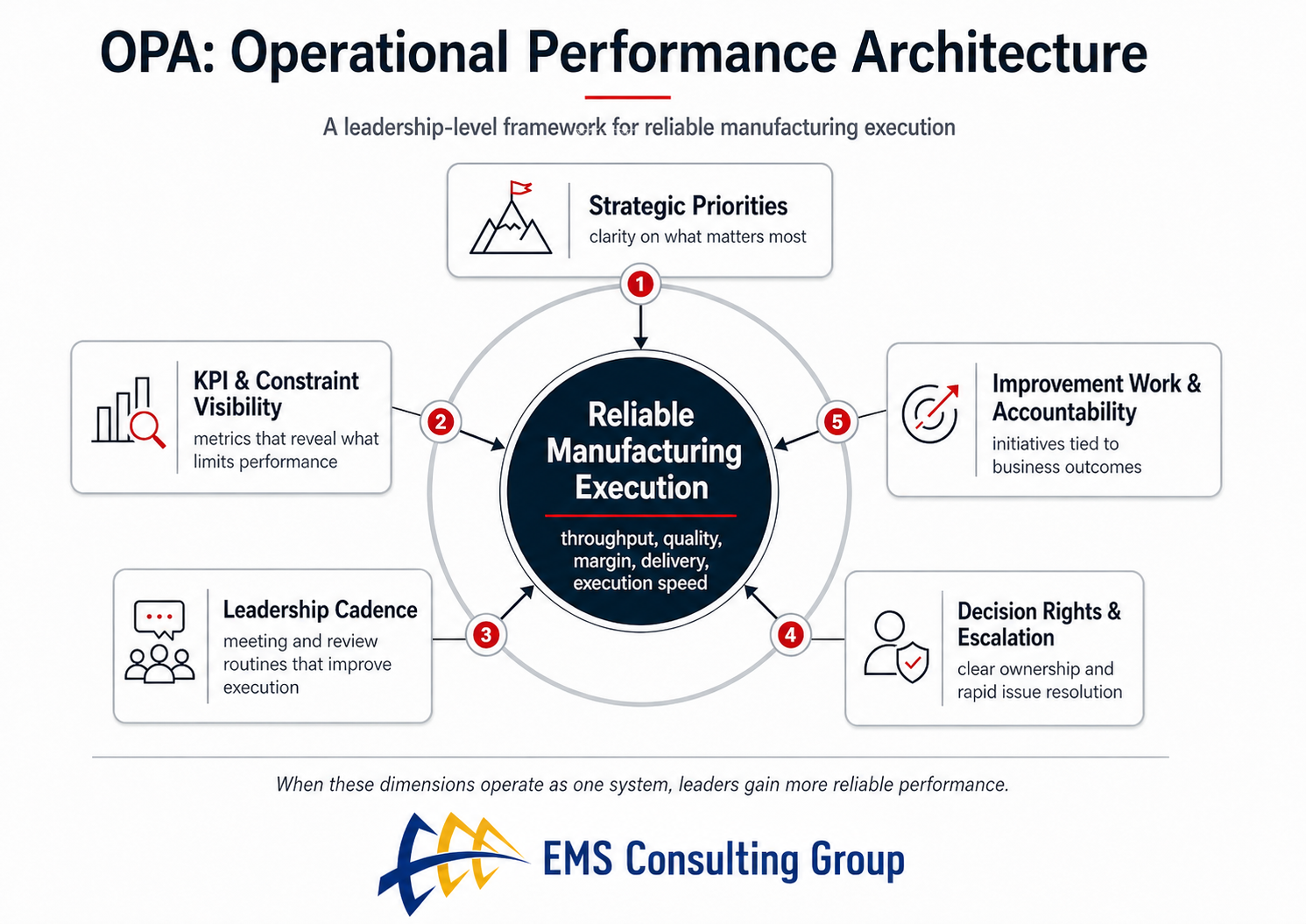
Building a reliable operating system for manufacturing execution
Many manufacturing organizations do not lack effort, tools, or improvement activity. The larger issue is that priorities, KPIs, constraints, decision rights, leadership cadence, and improvement work are often not operating as one system.
Schedule an Executive Conversation Learn How OPA Can Be Applied
In a brief conversation, we’ll clarify your operating context and determine whether an OPA executive session or diagnostic would be useful.
What OPA is
OPA is a structured executive framework to assess whether the organization’s operating architecture is strong enough to produce reliable performance across priorities, metrics, constraints, leadership routines, and improvement work.
- Focused Diagnostic Review
- Architecture-level lens—above individual tools, events, or isolated initiatives
- Designed to surface execution constraints before they become recurring performance drag
OPA is not Lean training, not a kaizen event, and not a generic operational audit. It is a disciplined way to help leadership determine whether the operating system is actually helping the organization improve throughput, quality, margin, delivery, and execution speed.
A Smaller First Step: Execution Reliability Review
Some leadership teams are not ready for a broader OPA diagnostic or operating system architecture review. In those cases, the Execution Reliability Review can provide a focused first step.
The Review is a concise, executive-level look at whether priorities, improvement activity, leadership routines, ownership, decisions, escalation, and follow-through are translating into sustained operating results.
It is especially useful when leaders want an outside perspective before deciding whether a larger OPA diagnostic, 90-Day Executive Plan, advisory engagement, or targeted improvement effort is warranted.
In practical terms, the Execution Reliability Review helps leadership determine whether the execution system is strong enough to convert improvement activity into measurable, sustained performance — and where the next 30 days of attention should be focused.
Explore the Execution Reliability Review View the Execution Reliability Book
What Leaders Walk Away With
OPA is not a report for the shelf. The goal is to give leadership a clearer operating architecture for improving execution in the normal rhythm of the business.
Depending on the organization’s needs, the work may produce:
- A clearer set of operating priorities tied to business outcomes
- A practical view of the constraints limiting execution, flow, quality, delivery, or margin
- A stronger KPI and performance-review structure
- Clearer decision rights and escalation paths
- A redesigned leadership cadence for daily, weekly, and monthly execution
- A clearer view of where executive intent is breaking down between leaders, managers, supervisors, and operational teams
- A prioritized 90-day execution roadmap
- Recommendations for advisory support, targeted improvement, or broader Enterprise Operating System implementation
The practical test of OPA is whether leaders can make better decisions, focus on the right constraints, escalate issues faster, and improve follow-through in the normal rhythm of the business — not just during special improvement events.
Before and After OPA
Before
Priorities shift, KPIs are reviewed but not acted on, improvement projects compete for attention, and unresolved issues linger between meetings.
After
Leaders have clearer priorities, better constraint visibility, defined decision rights, a stronger escalation path, and a cadence that turns performance issues into timely action.
Where OPA applies
OPA is designed for executive and senior operations teams responsible for improving performance in manufacturing and operations-heavy environments.
- Intended audience: CEOs, presidents, COOs, general managers, operations leaders, and cross-functional decision-makers
- Scope: the operating architecture spanning priorities, KPIs, constraints, leadership cadence, decision rights, improvement work, and accountability
- Primary purpose: identify whether performance improvement is being supported by a coherent operating system or slowed by disconnected efforts
OPA is not intended to impose a methodology on the organization. It is intended to help leadership see where execution is breaking down, clarify what the operating system must do better, and determine the most useful next step.
In manufacturing environments, performance strain often appears as firefighting, missed commitments, inconsistent priorities, unclear escalation, stagnant KPIs, or improvement activity that does not translate into business results. OPA helps leaders determine whether those symptoms are isolated problems or signs of a deeper architecture gap.
OPA: Operational Performance Architecture